
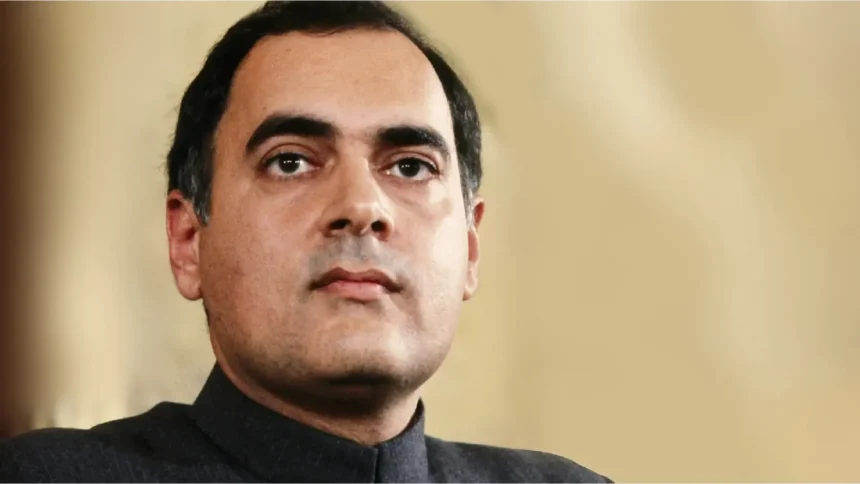
Former Indian Prime Minister Rajiv Gandhi was assassinated on this day, May 21. Today is Rajiv Gandhi’s death anniversary. So today we will tell the story of how Rajiv Gandhi was assassinated.
Rahul paid tribute to his father
On the death anniversary of Rajiv Gandhi, his son and Congress leader Rahul Gandhi paid tribute to him at Veer Bhumi on his 35th death anniversary and remembered his vision.
While posting on his X account, Rahul wrote “Papa, I will fully shoulder the responsibility of realizing the dream of a skilled, prosperous, and strong India that you envisioned. Your teachings, your values, and your memories will always remain with me.”
पापा, आपने जिस कुशल, समृद्ध और मजबूत भारत का सपना देखा था, उसे साकार करने की जिम्मेदारी मैं पूरी करूंगा।
आपकी सीख, आपके संस्कार और आपकी यादें हमेशा मेरे साथ रहेंगी। pic.twitter.com/uToSqMGdY3
— Rahul Gandhi (@RahulGandhi) May 21, 2026First, Let’s begin with his rise to Prime Minister. Indira Gandhi was assassinated on October 31, 1984 by her bodyguards. Following this, her son, Rajiv Gandhi became Prime Minister on the same date, and President Giani Zail Singh administered the oath of office to him. At just 40 years old, he became India’s youngest Prime Minister. Gandhi had a highly modern outlook and a desire to free India from corruption.
Establishment of LTTE
Meanwhile, in 1976, Velupillai Prabhakaran founded the Tamil separatist organization Liberation Tigers of Tamil Eelam (LTTE). The organization’s goal was to establish a separate Tamil state in Sri Lanka and fight against the oppression of the Tamil people. The LTTE had the support and sympathy of the Indian government. During Indira Gandhi’s tenure, India’s intelligence agencies also provided training and support to some Tamil groups.
Deployment of Peace Keeping Force in Sri Lanka
However, in 1987, an agreement was signed between Indian and Sri Lankan government. After this, Prime Minister Gandhi sent the Indian Peacekeeping Force to Sri Lanka to end the conflict and disarm the LTTE. Initially, the LTTE welcomed the Indian Peacekeeping Force. However, over time, the situation changed, and the LTTE began to perceive this as Indian interference. They then launched a front against the Indian Army, which the LTTE suffered as a result.
LTTE’s displeasure with Gandhi
The LTTE was disgruntled after the deployment of the Peacekeeping Force in Sri Lanka. They disliked Rajiv Gandhi. The Congress Party was voted out of power in 1989, but remained in the opposition. Consequently, in 1991, Rajiv Gandhi once again campaigned for the elections. During this time, he stated in an interview that if he returned to power, he would send a peacekeeping force to Sri Lanka. The LTTE was well aware that if Rajiv Gandhi became Prime Minister again, he would again deploy the peacekeeping force to Sri Lanka.
His assassination planning
So, LTTE began planning to assassinate Rajiv Gandhi. This was no small-scale planning; rather, the assassination was planned on a large scale. Meanwhile, on May 21, 1991, Rajiv Gandhi was about to address an election rally in Sriperumbudur, Tamil Nadu. There, a female suicide bomber named Thenmozhi “Gayathri” Rajaratnam approached Rajiv Gandhi under the pretext of garlanding him and then detonated the bomb. Fourteen people, including Rajiv Gandhi, were killed in the blast. It should be noted that Thenmozhi, the suicide bomber, was a member of the LTTE. However, before the attack, Rajiv Gandhi had been advised not to attend the rally. However, Rajiv Gandhi did not agree, resulting in his death in the suicide attack on May 21st.
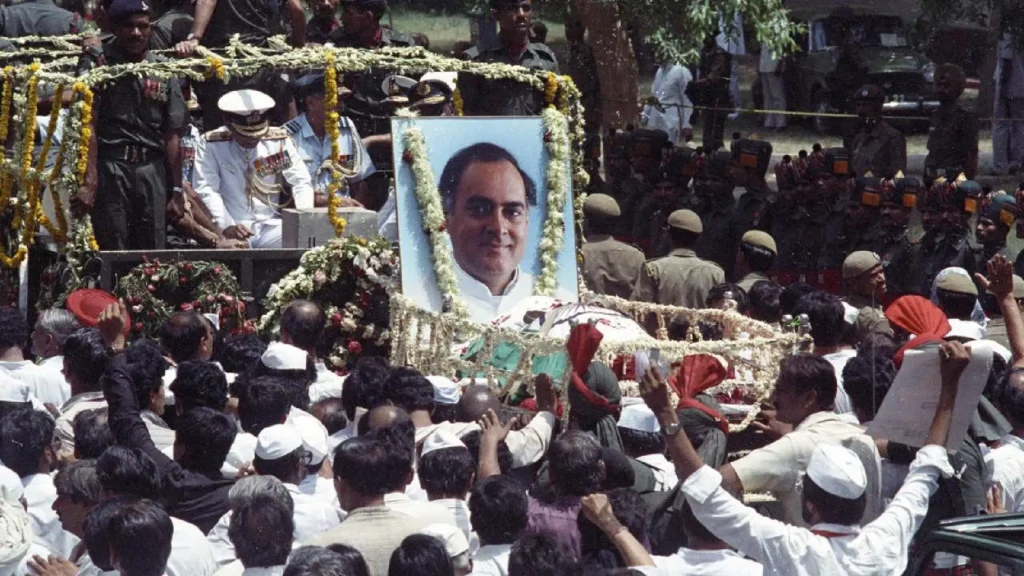
The fateful night of May 21, 1991, saw Rajiv Gandhi tragically die in a bomb blast in Sriperumbudur, Tamil Nadu, at 10:21 p.m. His body arrived in Delhi the next day. His body was kept at Teen Murti Bhavan for public viewing. The funeral took place on May 24. By then, Rahul Gandhi had returned from the United States. He lit his father’s funeral pyre at Shakti Sthal.
People were standing from Teen Murti to Veerbhoomi
Rajiv Gandhi’s funeral procession departed Lutyens’ Delhi and was approaching its destination via ITO. Millions of Delhiites lined both sides of the road to pay their last respects to their beloved leader. Braving the heat, mourners remained unmoved from the streets. Everyone bid him a tearful farewell. Previously, the funeral processions of Pandit Jawaharlal Nehru, Indira Gandhi, and Sanjay Gandhi had passed through these same roads. Even then, millions of people lined the streets. Mahatma Gandhi’s funeral procession also passed through this same route. It is said that hundreds of people brought ghee from their homes for the funeral. Thousands shaved their heads.
The brutal assassination of Rajiv Gandhi is a blow to our national conscience and a stain on Indian democracy. Once again, our great civilization and ancient culture have become a subject of global ridicule. Perhaps no other country in the world talks so much about nonviolence, but perhaps no other country in the world has seen politicians die in such a violent manner. This cycle of violence and murder must end.
Independent India will always be indebted to the late Rajiv Gandhi for his significant contributions. Rajiv Gandhi’s birth anniversary is celebrated as “Goodwill Day” and “Renewable Energy Day,” while his death anniversary, May 21, is commemorated as “Balidan Diwas.”
Read more: Security Team Faces Backlash At Jr NTR Birthday Event
Edited by: Bhoomi Goyal